
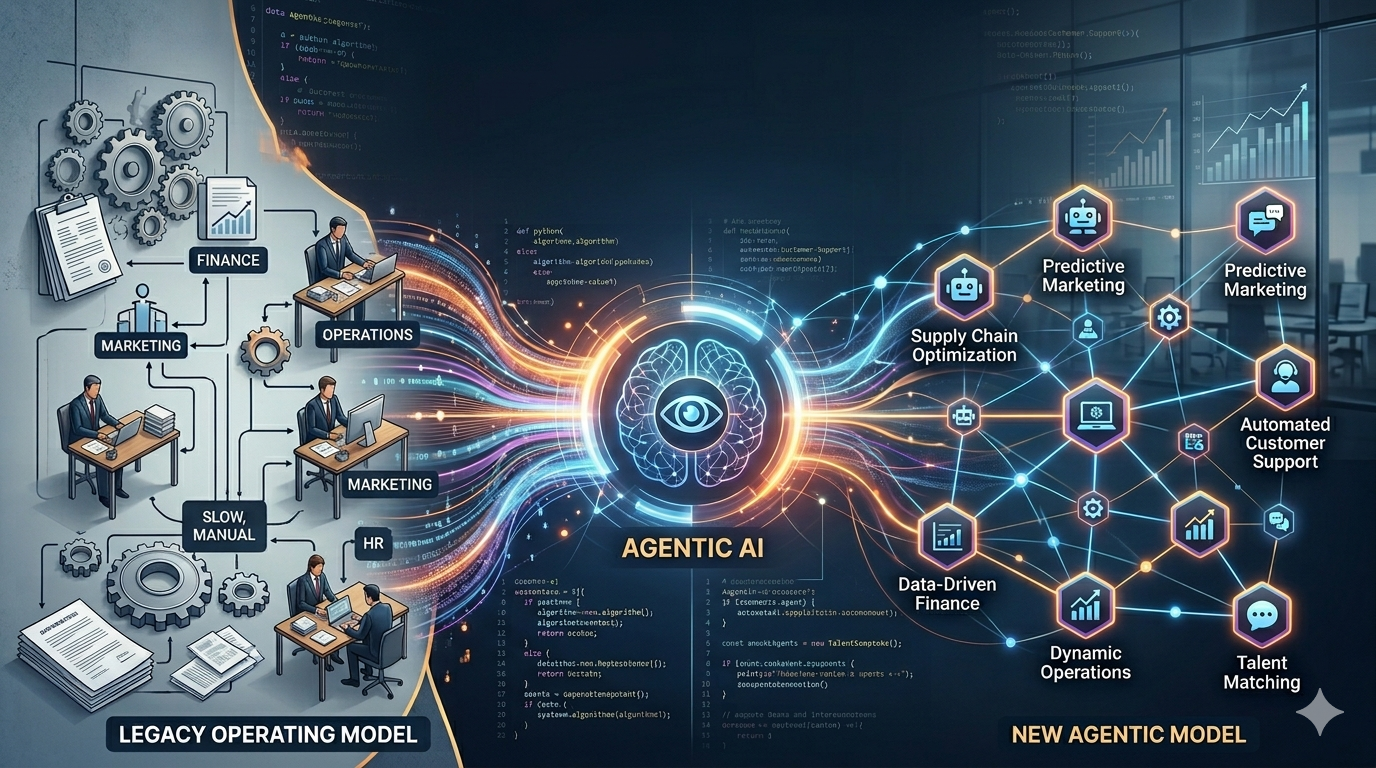
That question, posed by Harvard Business School professor Dr. Karim Lakhani in Microsoft’s 2026 Work Trend Index Annual Report, is not rhetorical. It is the single most urgent strategic challenge facing business leaders today. And the answer demands not an upgrade to the organisation — but a rearchitecture of it.
Dr. Karim Lakhani, Harvard Business School — Microsoft 2026 Work Trend Index
The Burning Platform: Why the Old Model Cannot Hold
For decades, the operating model of the modern organisation has been built on the same architecture: hierarchical org charts, departmental silos, process handoffs between human specialists, and IT systems that exist to record and report on the work those humans do. It is a structure designed for a world where the only scalable form of intelligence was human intelligence — and where intelligence was expensive, scarce, and slow.
That world has ended. But most organisations are still running its operating model.
of surveyed C-suite executives are already running pilots on agentic AI, with some progressing to scaled deployments — yet a similar share report seeing no material impact on earnings.
Microsoft’s 2026 Work Trend Index, which analysed trillions of productivity signals and surveyed 20,000 AI users across ten countries, lays out the paradox in stark terms: employees are ready to reinvent how they work, but the system around them — metrics, incentives, and norms — continues to reinforce the old way. The report calls this the Transformation Paradox. Sixty-five percent of AI users fear falling behind if they don’t adapt quickly, yet 45% say it feels safer to focus on current goals than to redesign work with AI.
McKinsey’s December 2025 research adds a sharper edge: more than 80% of enterprises are already running pilots or scaling agentic AI deployments. Agentic AI is expected to drive a 20 to 30 percent compression in legacy service lines as agents take on execution tasks that once required entire teams of human specialists. Enterprises believe as much as 15 to 30 percent of current knowledge roles’ work could be taken on by agents over the next three years.
The Automation Trap: Why Replicating Human Teams Isn’t Enough
The first instinct of most organisations encountering agentic AI has been entirely rational: take the teams and workflows that already exist, and replace the slower, more expensive human components with AI agents. This was, in fact, the initial direction taken by Fuschia Systems when building its agentic AI platform. The approach showed genuinely promising results — tasks completed faster, costs dropped, capacity scaled. Early adopters were impressed.
But the model had a fundamental ceiling.
Fuschia Systems — reflecting on the evolution of the platform
The insight that emerged was this: automation of the old model is not transformation. When AI agents are forced to conform to organisational structures built for human cognitive constraints — single-threaded attention, the need for handoff meetings, limited working memory, fixed working hours — they inherit all of those constraints without the compensating benefits of human judgment, empathy, and contextual wisdom.
A human sales team needs handoffs because one person cannot hold the full context of every customer relationship simultaneously. An AI agent system has no such limitation. A human finance department has separate teams for AP, AR, FP&A, and reporting because cognitive specialisation is the only practical way to manage complexity at human scale. An agentic system can hold all of that context in parallel, routing work dynamically based on state and outcome — not org chart position.
EBITDA gains achieved by tech-forward enterprises who moved beyond the pilot phase. But most organisations remain stuck in experimentation mode — precisely because they automated old workflows rather than redesigning them.
Rearchitecting Work: What the New Operating Model Demands
The emerging consensus from Microsoft, McKinsey, Bain, and the California Management Review points to five interconnected shifts that define a genuinely new operating model.
1. From Org Charts to Work Charts
McKinsey argues that traditional hierarchical organisation charts must give way to agentic networks: flat, context-rich structures where work is organised around the exchange of tasks and outcomes rather than the assignment of roles. When intelligence is abundant and context can be shared instantly across an agent network, the entire rationale for hierarchical delegation — managing information scarcity and human cognitive limits — disappears.
2. From Execution to Intent
Microsoft’s Work Trend Index identifies the most critical reallocation of human effort: the shift from execution to intent. As AI agents take on the doing — analysis, synthesis, drafting, processing — human value concentrates in setting clear intent, defining quality standards, and owning outcomes. Their analysis found that 49% of all AI-assisted interactions support cognitive work. The most effective workers will be those who redefine their value around what only humans can do: judgment, taste, ethical accountability, and the design of work systems themselves.
3. From Siloed Functions to Outcome-Oriented Workflows
McKinsey identifies the most transformative emerging value proposition as the End-to-End Workflow Disruptor — going beyond deploying individual agents to redesigning entire customised workflows with deep domain expertise. When an AI agent can pull data from ERP, analyse it in a financial model, and trigger an HR action within a single workflow, the organisational boundary between Finance, HR, and Operations ceases to be a structural necessity. It becomes a choice.
4. From Static Processes to Learning Systems
Microsoft identifies the most profound shift as the emergence of the organisation as a Learning System. As agents execute work at scale, they generate continuous signals: what worked, what failed, where quality drifted. Frontier Firms capture these signals and encode them into shared routines, building what Microsoft calls Owned Intelligence — institutional know-how that compounds over time, is unique to the firm, and is extraordinarily hard to replicate. Active agents in the Microsoft 365 ecosystem grew 15x year over year.
Upper estimate of the annual value pool from transforming core business functions through joint human-agent operating models — particularly in knowledge roles. Over 70% of this opportunity spans financial services, retail, high tech, healthcare, and manufacturing.
5. From Periodic to Embedded Governance
As agents operate continuously across functions, governance cannot remain a periodic, paper-heavy exercise. The California Management Review’s March 2026 analysis proposes that AI agents have transitioned from tools to actors — systems that independently perceive, decide, and act. Governance must become real-time, data-driven, and embedded, with humans holding final accountability.
The Four Pillars of an Agentic Operating Model
| Work Architecture Organise around outcomes and tasks, not roles and departments. Replace org charts with dynamic workflow graphs. Let context flow freely across agent networks. |
Human–Agent Interface Define where judgment, intent, and accountability sit with humans. Design clear escalation paths, human-in-the-loop checkpoints, and quality review frameworks. |
| Owned Intelligence Capture what agents learn. Build feedback loops that encode successful patterns into shared routines. Turn agent outputs into institutional knowledge that compounds. |
Embedded Governance Monitor agent behaviour in real time. Assign permissions, identities, and policy constraints to agents as managed entities. Make trust a structural property of the system. |
Where Fuschia Fits: Designing for the New Operating Model
Fuschia Systems was built to make this new operating model practically achievable — for businesses of any size, not just large enterprises with armies of AI engineers. The platform was designed around a core insight: the bottleneck to agentic transformation is not the availability of AI models. It is orchestration — coordinating the right agent, at the right time, with the right information, in the right relationship to human oversight and to every other agent in the workflow.
Context Engineering at the Core
One of Fuschia’s most distinctive capabilities is context engineering — systematically ensuring every agent has the information it needs to make good decisions: clear instructions, access to company data and customer histories, memory of past interactions, and the ability to invoke tools and integrate with existing systems. This is the foundational requirement for moving from the old model (agents replicating human tasks) to the new model (agents organised differently around what they are actually capable of).
Orchestration for Scale
The Fuschia platform coordinates agent collaboration across entire multi-agent workflows — managing handoff logic between specialised agents, ensuring generalist agents escalate to specialists when needed, and surfacing decisions for human review when complexity or risk exceeds defined thresholds. Real-time visual monitoring provides the transparency that embedded governance demands: showing active agents, their decisions, the state of each task, and precisely when human input is required.
Memory as Institutional Learning
Fuschia’s memory system captures patterns across workflows over time — enabling agents to generate deeper insights and continuously improve automation performance. Every interaction feeds back into the system’s understanding of what good looks like for that business, that workflow, and those customers. This is the mechanism that turns Fuschia from a workflow tool into what Microsoft calls a Learning System.
The Leadership Imperative
None of this happens by accident. The Microsoft research is unambiguous: organisational factors — culture, manager support, talent practices — account for more than twice the reported AI impact of individual factors like mindset and behaviour (67% vs. 32%). The biggest barrier to capturing the value of agentic AI is not the technology. It is leadership.
The Transformation Paradox is fundamentally a leadership problem. When only 13% of workers say they are rewarded for reinvention of work with AI even when results aren’t immediately met, the system is actively selecting against the very behaviours needed to build a new operating model. The metrics, incentives, and norms of the industrial-era org chart continue to reinforce old ways of working — even as individuals race to adopt new tools.
The organisations pulling ahead — what Microsoft calls Frontier Firms — have made a deliberate choice to redesign the system, not just the tools. Their leaders use AI themselves, set quality standards for AI-assisted work, create psychological safety around experimentation, and reward reinvention regardless of short-term outcome. In organisations with this kind of leadership, employees report a 17-point lift in AI value, a 22-point lift in critical thinking, and a 30-point lift in trust in agentic AI.
Microsoft 2026 Work Trend Index Annual Report
The Architecture of the Next Era
The industrial era was defined by the design of scale. The information age by the design of coordination. The agentic AI era will be defined by the design of judgment, learning, and coordinated action across humans and machines.
The businesses that win will not be the ones that accumulate the most AI tools. They will be the ones that build operating models capable of turning local gains into institutional advantage — organisations in which every agent action teaches the system something, and every human decision focuses on what only humans can do.
The architecture of that organisation exists today. The question is simply whether leaders are willing to do the work to build it. Platforms like Fuschia exist precisely to make that work tractable — starting with a single process, proving value, and scaling into a fundamentally different kind of enterprise. Not one that runs like a human team, only faster. One that runs in ways human teams never could.
See Fuschia in Action
Discover how the Fuschia platform helps you design agentic workflows — starting small and scaling as you prove value.
Sources & References
Microsoft 2026 Work Trend Index Annual Report — “Agents, human agency, and the opportunity for every organization” (May 2026)
McKinsey & Company — “Reimagining the value proposition of tech services for agentic AI” (December 2025)
McKinsey & Company — “The agentic organization: A new operating model for AI” (September 2025)
Bain & Company — “State of the Art of Agentic AI Transformation”, Technology Report 2025
California Management Review — “Governing the Agentic Enterprise” (March 2026)